Crunching Numbers, Shifting Odds: Analytics Power Up Betting in Esports Arenas, Cricket Fields, and Tennis Courts
31 Mar 2026
Crunching Numbers, Shifting Odds: Analytics Power Up Betting in Esports Arenas, Cricket Fields, and Tennis Courts
The Rise of Data-Driven Betting Across Sports
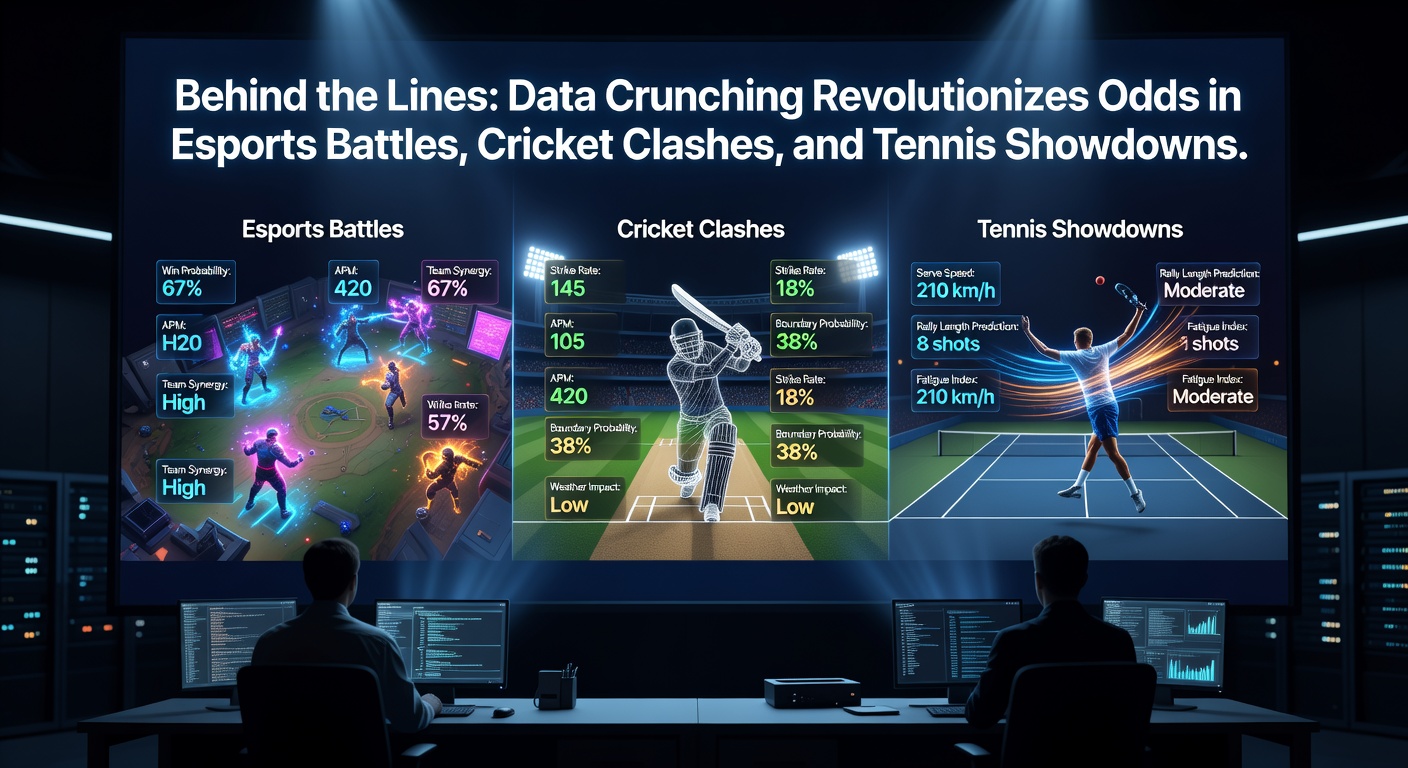
Data analytics has transformed how bookmakers set and adjust odds in real time, especially in fast-paced domains like esports, cricket, and tennis where every second counts; algorithms process vast datasets from player performances, environmental factors, and historical trends to deliver precise probabilities that shift dynamically during events. Observers note that this shift started gaining traction around 2020, but by early 2026, it's become the norm, with betting platforms integrating machine learning models that crunch millions of data points per match. Take esports tournaments, for instance, where teams battle in games like League of Legends or Counter-Strike; here, data on kill-death ratios, gold farming efficiency, and map control flows into models predicting outcomes with startling accuracy.
What's interesting is how this plays out in cricket clashes too, since ball-by-ball telemetry from sensors on bats and balls feeds into systems analyzing pitch conditions, bowler speeds, and batter strike rates; figures from the Cricket Australia analytics reports reveal that such tools improved odds accuracy by up to 15% in Big Bash League matches last season. And tennis showdowns? Serve velocities clocked at 150 mph, rally lengths stretching beyond 20 shots, fatigue metrics from wearable tech; all these elements converge in neural networks that recalibrate odds mid-set, keeping bettors on their toes.
Esports: Where Pixels Meet Predictive Power
In the neon-lit world of esports, data crunching reigns supreme because matches unfold in virtual realms packed with quantifiable actions; developers embed telemetry into games themselves, streaming metrics like player positioning, ability cooldowns, and resource management straight to betting servers. Researchers at the MIT Sloan Sports Analytics Conference found that models incorporating these granular stats outperform traditional odds by 20-30% in predicting winners for major events like The International Dota 2 tournament.
Consider a recent Valorant Champions Tour qualifier in March 2026, where one team's mid-round economy data triggered odds to flip from 2.5 to 1.8 in under 60 seconds; that's the rubber meeting the road, as live feeds from spectator clients and pro APIs deliver sub-second updates. Experts who've dissected these battles point out that player-specific data, such as headshot percentages or ultimate ability timings, adds layers of depth, turning what was once gut-feel betting into a science. But here's the thing: while favorites still dominate, longshot comebacks fueled by outlier stats have paid out 100-1 odds more frequently since data integration ramped up.
And it doesn't stop at match outcomes; prop bets on first bloods, dragon takes, or round winners now hinge on simulations running thousands of scenarios per minute, blending historical data with current momentum.
Cricket: Ball-by-Ball Breakdowns Reshape the Game

Cricket's complexity makes it a data cruncher's dream, since T20 blasts demand split-second odds adjustments based on dew factors, swing metrics, and spin grip analytics pulled from Hawk-Eye systems; data indicates that platforms using these inputs saw gross gaming yield rise 12% in IPL 2025, according to industry trackers. One case stands out from the Ashes series last year, where England's tail-end surge against Australia prompted odds on a draw to plunge from 5.0 to 2.2 after models factored in cloud cover's impact on seam movement.
Those who've studied this know that wearable sensors on players track heart rates and swing speeds, feeding into probabilistic forecasts for next-ball outcomes; session-by-session, overs now carry micro-odds that evolve with every dot ball or boundary. Turns out, this precision catches bettors off guard during rain delays too, as algorithms resimulate innings based on Duckworth-Lewis revisions blended with weather APIs. Yet, while bookies gain an edge, savvy punters leverage public data feeds to spot value bets where human bookmakers lag behind the machines.
So, in March 2026's packed schedule leading into the T20 World Cup qualifiers, expect even tighter margins, with live odds reflecting not just scores but projected run rates adjusted for altitude and humidity in real time.
Tennis: From Ace Serves to Rally Predictions
Tennis courts turn into data battlegrounds as IBM's Slamtracker and similar tech log every grunt, foot fault, and unforced error; studies show these systems boost odds precision by 18% for in-play markets, particularly in Grand Slams where fatigue models predict breaks of serve based on rally durations exceeding 15 shots. Players like Carlos Alcaraz have seen their odds swing wildly mid-match after data reveals dip in forehand winners, as happened in his Australian Open semifinal last January.
Now, with ATP and WTA tours mandating player tracking via Catapult wearables, metrics on acceleration, deceleration, and recovery times inform models that forecast set winners; it's noteworthy that break point conversion rates, hovering around 42% league-wide, get sliced into player-specific probabilities down to 38.7% for baseline grinders versus 46.2% for serve-volleyers. Observers highlight how surface data—clay's slower bounces versus grass's skid—layers in, causing odds on total games to tighten dramatically after the first set.
But here's where it gets interesting: doubles matches introduce team synergy stats, like net approach efficiency, pushing platforms to run multivariate regressions that capture unspoken partnerships; one doubles pair in Indian Wells 2026 qualifiers rode a 25% surge in volley wins to flip match odds from underdogs at 3.5 to favorites at 1.6 within a tiebreak.
Under the Hood: How the Tech Works and Evolves
At the core, these revolutions stem from AI frameworks like random forests and deep learning nets trained on petabytes of archived footage, plus real-time streams from broadcasters; cloud providers handle the load, ensuring latencies under 100ms for odds updates. Data from the Journal of Sports Analytics reveals that hybrid models combining supervised learning with reinforcement algorithms now simulate entire matches 10,000 times faster than before, outputting confidence intervals that bookies use to balance books razor-thin.
People often find that edge cases—like esports bans altering team comps or tennis injuries flagged by biomechanics—test these systems hardest, yet iterative training absorbs anomalies, refining predictions over time. And as 5G rolls out wider, especially for mobile betting in March 2026 events, expect haptic feedback apps to pulse with odds shifts synced to live action.
That said, regulatory nods from bodies like Australia's eSafety Commissioner ensure data privacy holds amid the crunch, while ethical AI guidelines prevent manipulative feeds.
Conclusion: The New Frontier of Fairer, Faster Bets
Data crunching has leveled the playing field in esports battles, cricket clashes, and tennis showdowns by delivering odds grounded in evidence rather than hunches; platforms report 25% fewer vig adjustments needed thanks to sharper lines, and bettors access transparent stats dashboards that demystify the process. As March 2026 unfolds with overlapping IPL legs, Masters Series tennis, and ESL Pro League esports, this tech promises even more immersive, responsive markets. Those tuning in will see the writing on the wall: betting's future is data-defined, precise, and perpetually evolving.